Module 3
Why transition feels destabilising — and why that doesn’t mean you’re failing
*
Why transition feels destabilising — and why that doesn’t mean you’re failing *
IN THIS MODULE
After transition, many people are told to reinvent themselves.
New identity.
New purpose.
New direction.
But identity doesn’t work like that.
This module isn’t about becoming someone new.
It’s about recognising what already exists — and allowing it to evolve without pressure.
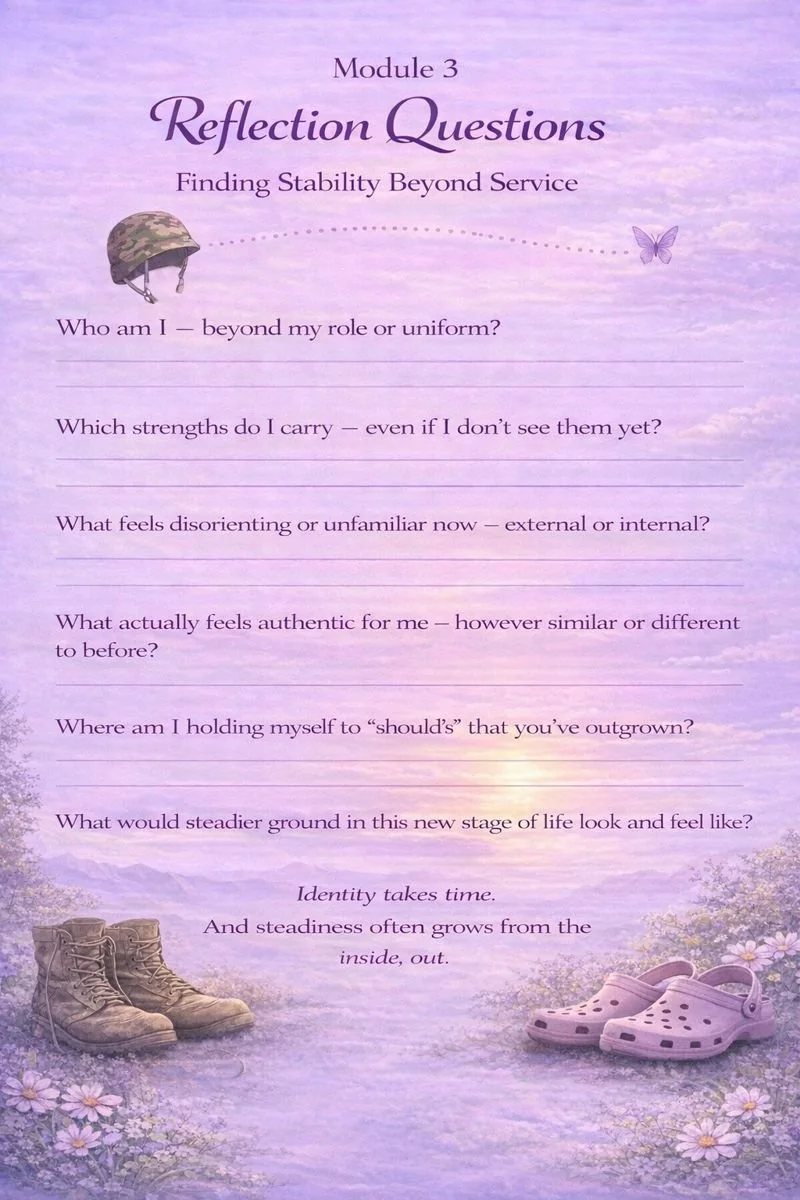
Reflection questions
What parts of me feel familiar, even now?
What parts feel quieter or harder to access?
Guidance
Research on identity change shows that forced reinvention increases distress, while integration supports stability.
You’re not starting from zero.
You’re carrying experience forward.
If this brings up emotion, pause.
Breathe out slowly.
Nothing needs to be resolved here.re clearly what’s happening inside you right now.
WHY “REINVENT YOURSELF” OFTEN FAILS
Service identity is layered.
It includes:
values
responsibility
judgement
belonging
lived experience
When people are told to discard that identity, it often creates confusion rather than freedom.
Identity adapts through continuity, not erasure.
Reflection question
What parts of my service identity still feel true, even if the role has changed?
Guidance
Psychological research on identity transition shows that continuity of self protects wellbeing during change.
You don’t need to abandon who you were.
You’re allowed to integrate it.
Pause here if needed.
Breathe gently.
****
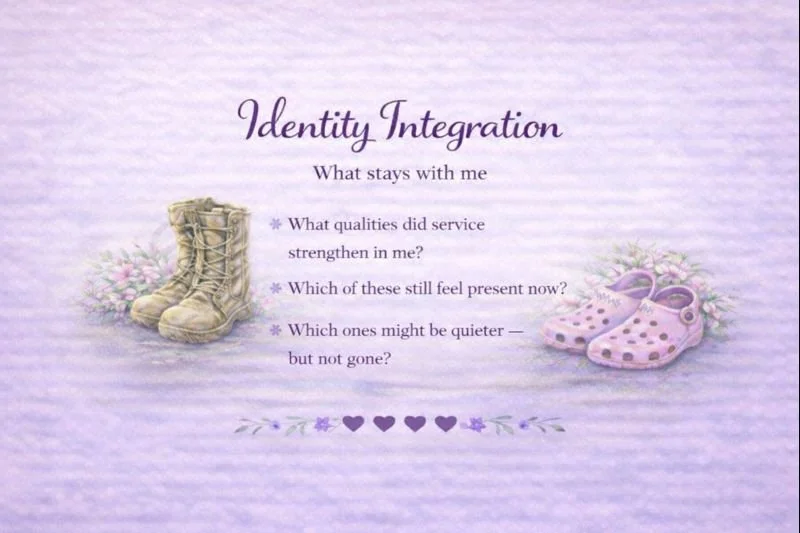
Before moving on, pause here.
What qualities did service strengthen in me?
Which of these still feel present now?
Which ones might be quieter — but not gone?
***
Scientific grounding
Research in identity psychology shows that recognising stable traits and values supports confidence and reduces identity confusion during major transitions.
This tool works because it:
preserves continuity
reduces loss narratives
supports self-trust
No action required.
Just noticing is enough.
VALUES VS ROLES VS LABELS
Roles change.
Labels change.
Values tend to remain.
When people feel lost after transition, it’s often because roles disappeared — not because values did.
Reflection questions
What mattered to me in service, beyond the role itself?
Where do I still live by those values, even quietly?
Guidance
Values-based research shows that clarity of values supports direction without forcing goals.
You’re not being asked to define anything yet.
Let this settle.
Reflection prompts
Which values guided how I showed up in service?
Which of these still matter now?
Where do I already live them, even outside work?
Scientific grounding
Research in wellbeing and behaviour change shows that values clarity increases psychological flexibility and resilience.
This tool avoids:
corporate language
performance framing
goal pressure
It supports direction without urgency.
Pause.
Breathe out slowly.
CONFIDENCE VS COMPETENCE
After transition, confidence often drops — even when competence hasn’t.
Without rank, structure, or recognition, capability can feel invisible.
This doesn’t mean you’ve lost it.
It means the context has changed.
Reflection question
Where might my competence still exist, even if it’s no longer recognised in the same way?
Guidance
Research on self-efficacy shows that confidence is context-dependent, while competence is more stable.
You’re not less capable.
You’re less mirrored.
Pause here if that lands.
Reflection prompts
What situations have I handled calmly or competently before?
What do people still come to me for?
What do I trust myself with, even now?
Scientific grounding
Research on leadership and identity transition shows that recognising internal competence restores confidence without external validation.
This tool:
rebuilds self-trust
avoids CV language
strengthens agency quietly
No comparison required.
****
PAUSE
Pause here.
Identity doesn’t resolve in one sitting.
Take a slow breath in.
Breathe out gently.
You’re allowed to take time with this.
****
You don’t need to reinvent yourself.
You are integrating experience, identity, and values — at your own pace.
What stays with you matters.
In the next module, we’ll look at Leadership Without Rank — how capability continues, even when hierarchy disappears.
You can continue when it feels right.