Module 6
Why transition feels destabilising — and why that doesn’t mean you’re failing
*
Why transition feels destabilising — and why that doesn’t mean you’re failing *
IN THIS MODULE
After transition, action can feel complicated.
You may want to move forward — but feel hesitant.
Or you may push yourself to act — and feel exhausted or disconnected afterwards.
This module isn’t about motivation, discipline, or momentum.
It’s about rebuilding trust in yourself through action that feels owned, realistic, and sustainable.
WHY ACTION CAN FEEL HARD AFTER TRANSITION
In structured environments, action is often:
directed
measured
externally validated
tied to outcomes
After transition, that scaffolding disappears.
Without clear feedback or structure, action can feel risky — especially when confidence has already taken a hit.
Hesitation here isn’t laziness.
It’s caution.
Reflection question
What do I notice when I think about taking action right now?
Guidance
Research into behaviour change shows that when confidence is low, the nervous system treats action as a potential threat rather than an opportunity.
This can show up as avoidance, procrastination, or overthinking — even when the desire to move forward is real.
Pause.
Take one slow breath out.
Nothing needs to be forced.
There’s no rush here. You don’t need answers yet. This module is about seeing more clearly what’s happening inside you right now.
SMALL ACTION BUILDS TRUST
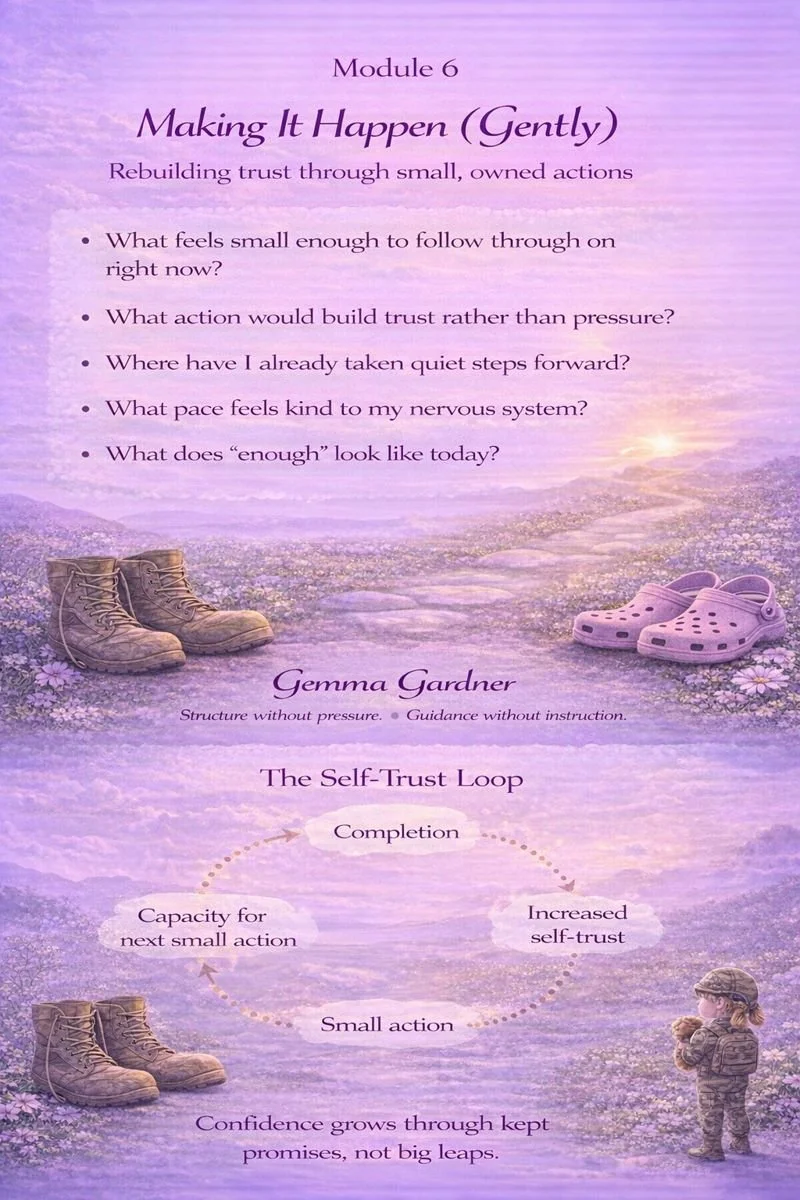
Trust isn’t rebuilt through big moves.
It’s rebuilt through kept promises — especially the small ones.
Action that feels manageable and self-directed sends a signal of safety to the nervous system.
This is how momentum returns — quietly.
Reflection question
What is one action I could take that feels small enough to keep?
Guidance
Behavioural psychology research shows that consistency strengthens self-trust more effectively than intensity.
Small actions that are completed — rather than ambitious actions that are abandoned — restore confidence over time.
Pause.
Let that land.
Reflection prompts
What actions have I avoided because they feel too big?
What feels possible without needing extra energy?
What would “enough” action look like right now?
CHOICE AS CONFIDENCE
Choosing — even in small ways — matters.
When much of life has been dictated by circumstance or structure, choice becomes a powerful signal of agency.
Action doesn’t need to be visible to others to count.
Reflection question
Where can I make a choice that’s entirely mine?
Guidance
Research into autonomy and motivation shows that ownership — not outcome — is what restores confidence and engagement.
When action is chosen rather than imposed, it strengthens self-belief.
Pause here if that feels unfamiliar.
Reflection prompts
What do I want to choose for myself this week?
Where do I already make quiet choices without acknowledging them?
What feels more like alignment than achievement?
CONSISTENCY OVER INTENSITY
Progress during transition rarely looks dramatic.
It looks like:
showing up gently
adjusting when needed
starting again without judgement
This is not failure.
It’s responsiveness.
Reflection question
What would consistency look like if I removed pressure?
Guidance
Research on habit formation shows that sustainable change comes from repetition within capacity — not from bursts of effort followed by exhaustion.
Gentle consistency creates stability.
You’re allowed to move slowly.
Reflection prompts
What pace feels kind to my nervous system?
What helps me return after a pause?
How do I usually speak to myself when things don’t go to plan?
SCIENTIFIC GROUNDING
Studies in self-efficacy show that confidence grows through mastery experiences — moments where effort leads to completion, however small.
Each small, owned action becomes evidence.
You’re not trying to feel confident first.
You’re allowing confidence to grow from experience.
****
PAUSE
Pause here.
You don’t need to do more.
You don’t need to push.
Take one slow breath in.
Breathe out gently.
Action doesn’t need to be loud to matter.
In the next module, we’ll look at looking forward without rushing — holding the future with steadiness rather than urgency.
You can continue when it feels right.