Module 2
Why transition feels destabilising — and why that doesn’t mean you’re failing
*
Why transition feels destabilising — and why that doesn’t mean you’re failing *
IN THIS MODULE
This module is about restoring capacity — not motivation, not goals, but the energy needed to think clearly again.
If you’re reading this, you may already be trying to work out what comes next.
That’s understandable — direction often feels urgent during transition. But clarity depends on capacity. When energy is depleted, decision-making becomes harder, confidence drops, and everything can feel heavier than it needs to.
This module invites you to pause the search for answers and look instead at how your energy is currently being used.
After transition, many people feel frustrated by a lack of motivation or direction.
They want to know:
What’s next? What should I be doing? Why can’t I decide?
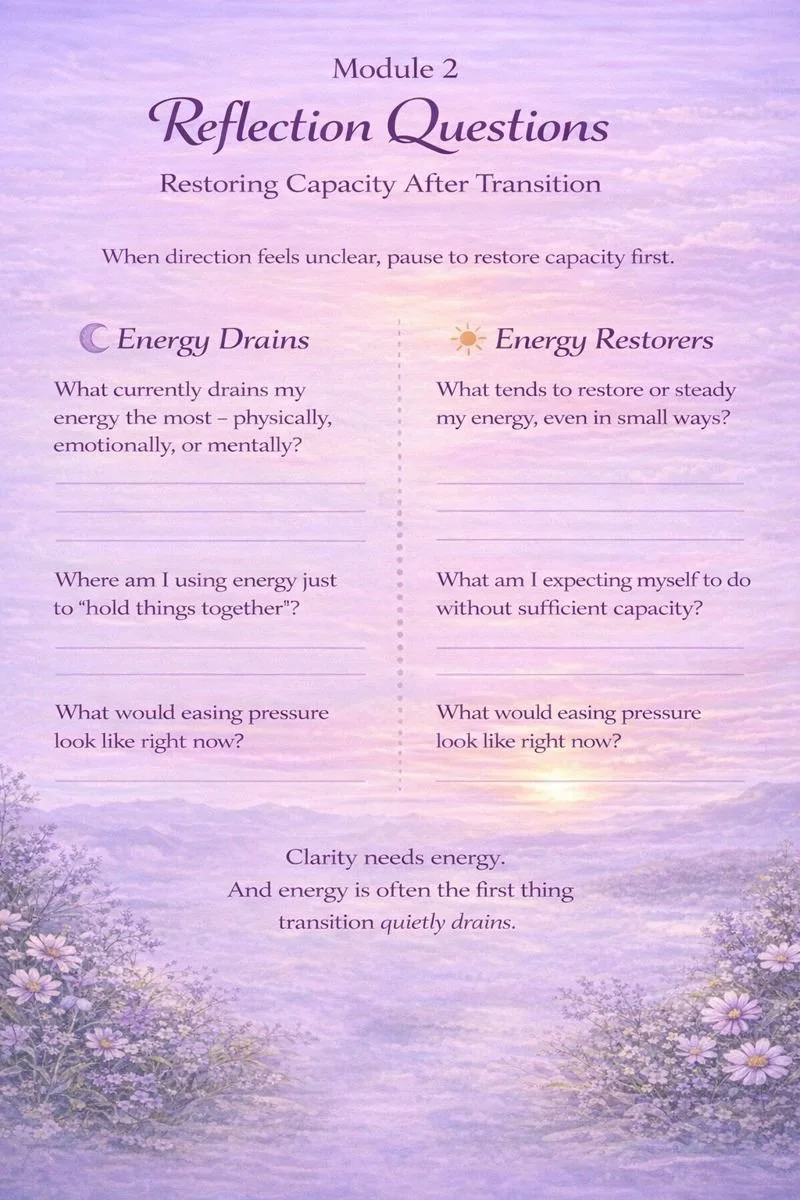
But clarity requires energy.
And energy is often the first thing transition quietly drains.
This module isn’t about finding answers.
It’s about restoring enough capacity so thinking becomes possible again.
Do I feel more tired than I expected to at this stage?
What have I been telling myself that tiredness means about me?
Research on stress and cognitive load shows that decision-making and motivation drop sharply when energy is low — even in capable, resilient people.
This isn’t laziness.
It’s biology.
If you notice self-criticism here, pause.
Take one slow breath in through your nose, and a longer breath out through your mouth.
You’re not behind.
You’re depleted — and that matters.
****
Before moving on, pause here.
WHY ENERGY DROPS AFTER TRANSITION
Service life often runs on heightened alertness.
Clear structure, responsibility, and urgency keep the nervous system engaged. When that drops away, the body doesn’t immediately feel relieved — it often feels exhausted.
This is a delayed response.
Many people only feel the fatigue after the pressure lifts.
Reflection question
What if my tiredness is a response to sustained effort — not a lack of resilience?
Guidance
Research into nervous system regulation shows that prolonged periods of responsibility and vigilance are often followed by energy dips, once safety increases.
You don’t need to push through this phase.
You need to let it pass.
Let this question sit.
No answer required.
REST WITHOUT GUILT
One of the hardest parts of this stage is allowing rest without judgement.
Rest can feel undeserved.
Or unproductive.
Or uncomfortable.
But rest isn’t something you earn.
It’s something your system requires to recalibrate.
Reflection questions
What does rest feel like in my body right now?
What thoughts show up when I slow down?
Guidance
Studies show that unstructured rest is essential for nervous system recovery — especially after prolonged structure and demand.
If rest feels unfamiliar or uneasy, that’s common.
Try not to change the experience.
Just notice it.
Take one steady breath.
Longer out than in.
***
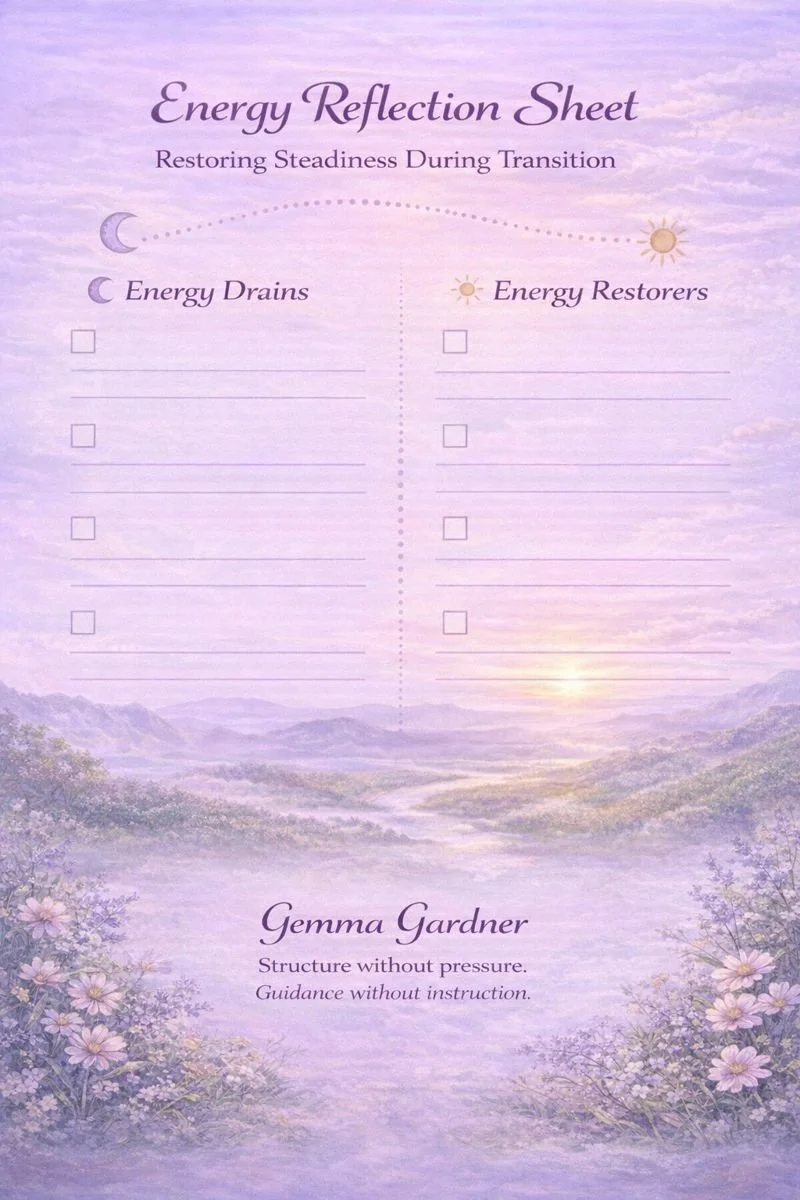
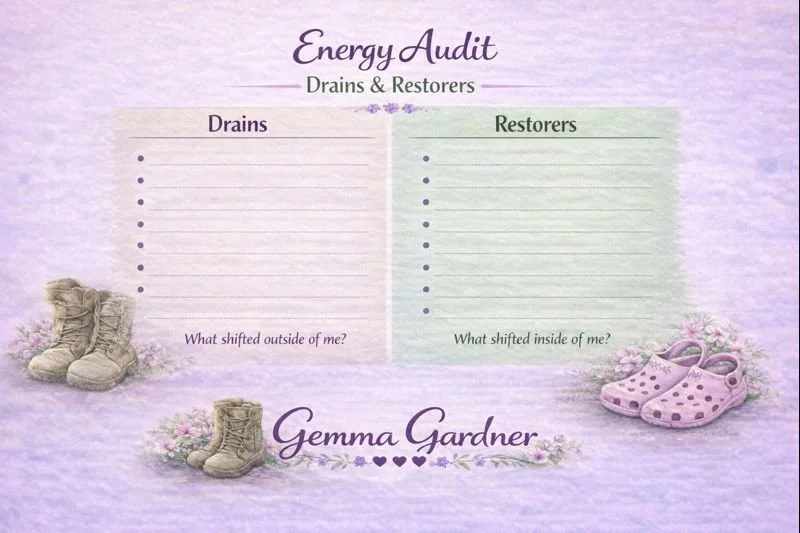
Energy Audit: Drains & Restorers
This tool helps you notice what costs energy — and what quietly restores it.
There’s no need to balance or fix anything yet.
This is about awareness, not optimisation.
Reflection questions
What situations, tasks, or environments drain my energy?
What helps me feel even slightly more settled or steady?
Guidance
Research into burnout and recovery shows that small, repeated restorers have more impact than occasional big breaks.
You are not meant to overhaul your life here.
Just noticing patterns helps your brain begin to protect energy naturally.
Pause.
Breathe out slowly.
STABILITY BEFORE MOTIVATION
Motivation often returns after stability, not before it.
Trying to force motivation when energy is low usually increases frustration and self-doubt.
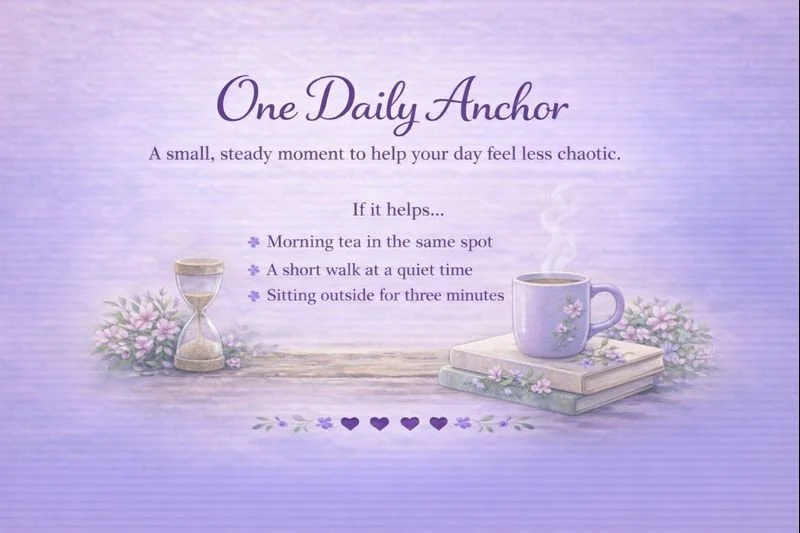
Stability comes from small, repeatable anchors — not big plans.
Reflection question
What is one small, steady thing that helps my day feel less chaotic?
Guidance
Research on habit formation and recovery shows that consistency matters more than intensity during periods of adjustment.
This isn’t about doing more.
It’s about doing less — more reliably.
No action required yet.
Just notice what already helps.
****
FAMILY & ENERGY
Energy changes affect relationships too.
When you’re depleted, communication, patience, and connection often take more effort.
This doesn’t mean you’re withdrawing.
It means your capacity is limited.
Reflection question
Where might I be using energy to manage other people’s expectations?
Guidance
Studies on relational stress show that emotional labour increases exhaustion.
You are allowed to conserve energy — even with people you care about.
Pause here if needed.
Breathe slowly.
NORMALISING THIS STAGE
Research consistently shows that during major life transitions:
energy dips before clarity returns
motivation fluctuates
decision-making capacity narrows
This phase doesn’t mean you’re stuck.
It means your system is recalibrating.
****
PAUSE
Pause here.
Take one slow breath in.
Hold gently.
Breathe out slowly.Nothing needs to be decided today.
****
Energy comes before direction.
Once capacity begins to return, clarity follows — often quietly, without forcing.
In the next module, we’ll look at identity beyond the uniform — not reinvention, but integration.
You can continue when it feels right.