
Module 4
Why transition feels destabilising — and why that doesn’t mean you’re failing
*
Why transition feels destabilising — and why that doesn’t mean you’re failing *
IN THIS MODULE
After leaving service, many people say the same thing:
“I don’t feel like a leader anymore.”
Without rank, uniform, or formal authority, leadership can feel like it vanished overnight. But leadership doesn’t live in hierarchy — it lives in judgement, responsibility, steadiness, and influence.
This module isn’t about stepping up or standing out.
It’s about recognising what’s already there.
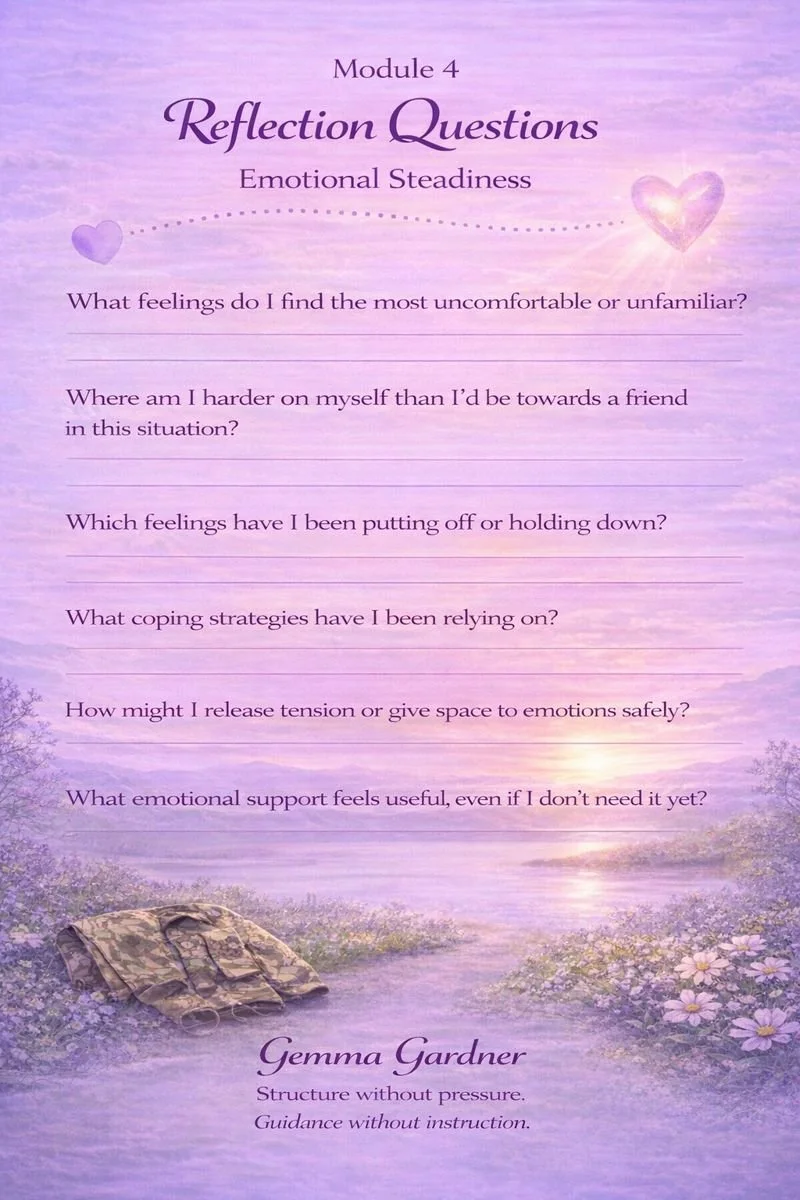
Reflection questions
Where do I notice a loss of confidence since leaving service?
What do I think leadership is supposed to look like now?
Guidance
Research in leadership psychology shows that confidence often drops when external markers of authority are removed, even though capability remains.
If this brings up doubt or grief, pause.
Take one slow breath out.
Nothing needs to be proven here.
A Gentle Pause
There’s no rush here. You don’t need answers yet. This module is about seeing more clearly what’s happening inside you right now.
WHY LEADERSHIP CAN FEEL INVISIBLE
In service, leadership is recognised:
through rank
through responsibility
through structure
Outside that system, leadership becomes quieter.
Decision-making, judgement, and restraint are still there — but they’re no longer named or mirrored back.
That doesn’t mean they’ve gone.
It means the context has changed.
Reflection question
Where might I still be leading, without calling it that?
Guidance
Leadership research shows that informal leadership — influence without authority — is often overlooked, even though it’s highly effective.
You may be doing more than you realise.
Pause.
Let that land.
****
Before moving on, pause here.
You don’t need clarity yet.
You don’t need a plan yet.
***
Reflection prompts
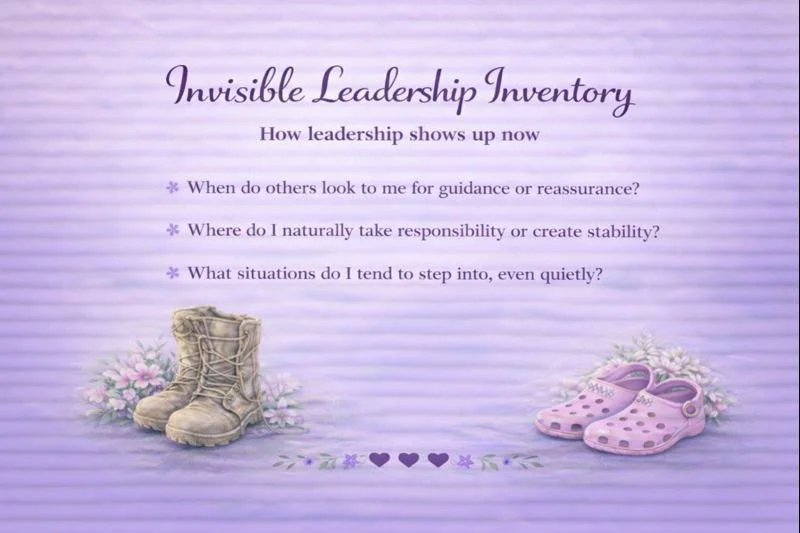
When do others look to me for guidance or reassurance?
Where do I naturally take responsibility or create stability?
What situations do I tend to step into, even quietly?
Scientific grounding
Research on informal leadership shows that influence, trust, and judgement are stronger predictors of leadership effectiveness than title or position.
Recognising this restores confidence without ego.
No action required.
Just noticing is enough.
CONFIDENCE VS CAPABILITY (AGAIN)
Confidence is often mistaken for competence.
But confidence is shaped by:
recognition
feedback
structure
Capability is shaped by experience.
When recognition drops, confidence follows — even when capability hasn’t changed.
Reflection question
What do I know how to handle now that once felt difficult?
Guidance
Self-efficacy research shows that remembering past mastery experiences is one of the most reliable ways to restore confidence.
You’re not trying to feel confident.
You’re remembering evidence.
Pause.
Breathe out slowly.
Reflection prompts
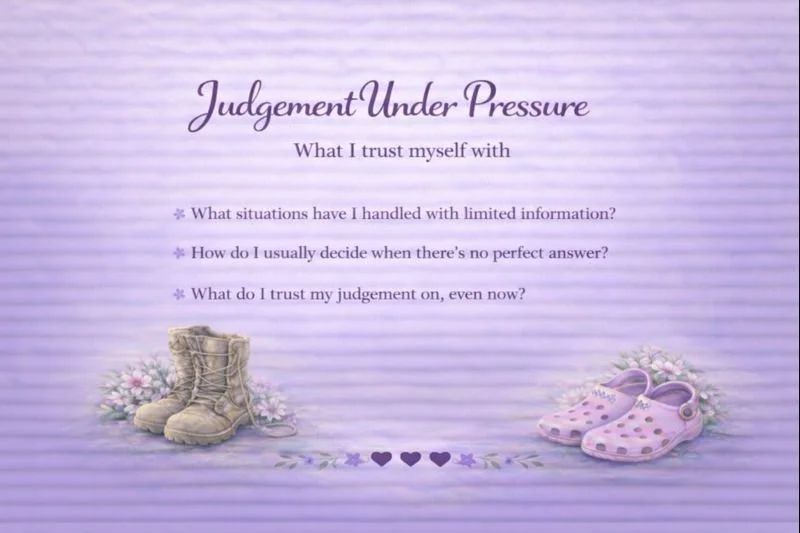
What situations have I handled with limited information?
How do I usually decide when there’s no perfect answer?
What do I trust my judgement on, even now?
Scientific grounding
Decision-making research shows that experienced judgement develops through exposure, not confidence.
You don’t lose this skill when you leave service.
You carry it with you.
INFLUENCE WITHOUT AUTHORITY
Leadership after service often looks like:
setting tone
holding boundaries
modelling calm
knowing when not to act
This kind of leadership doesn’t announce itself.
But it matters.
Reflection question
Where do my actions influence others, even without formal authority?
Guidance
Social psychology research shows that behavioural modelling is one of the strongest forms of influence.
You don’t need permission to lead this way.
Pause here if that feels unfamiliar.
Reflection prompts
How do people tend to respond when I’m present?
What do I bring into a room without trying?
What kind of steadiness do I offer others?
Scientific grounding
Research on emotional regulation and leadership shows that calm presence and consistency strongly influence group dynamics.
This is leadership — even when it’s quiet.
****
PAUSE
Pause here.
Leadership doesn’t disappear when rank does.
Take one slow breath in.
Breathe out gently.
****
You don’t need to reclaim leadership.
You never lost it.
What’s changed is the structure around it — not the capability within you.
In the next module, we’ll look at planning that serves you — creating direction without pressure or performance.
You can continue when it feels right.