Module 7
Why transition feels destabilising — and why that doesn’t mean you’re failing
*
Why transition feels destabilising — and why that doesn’t mean you’re failing *
IN THIS MODULE
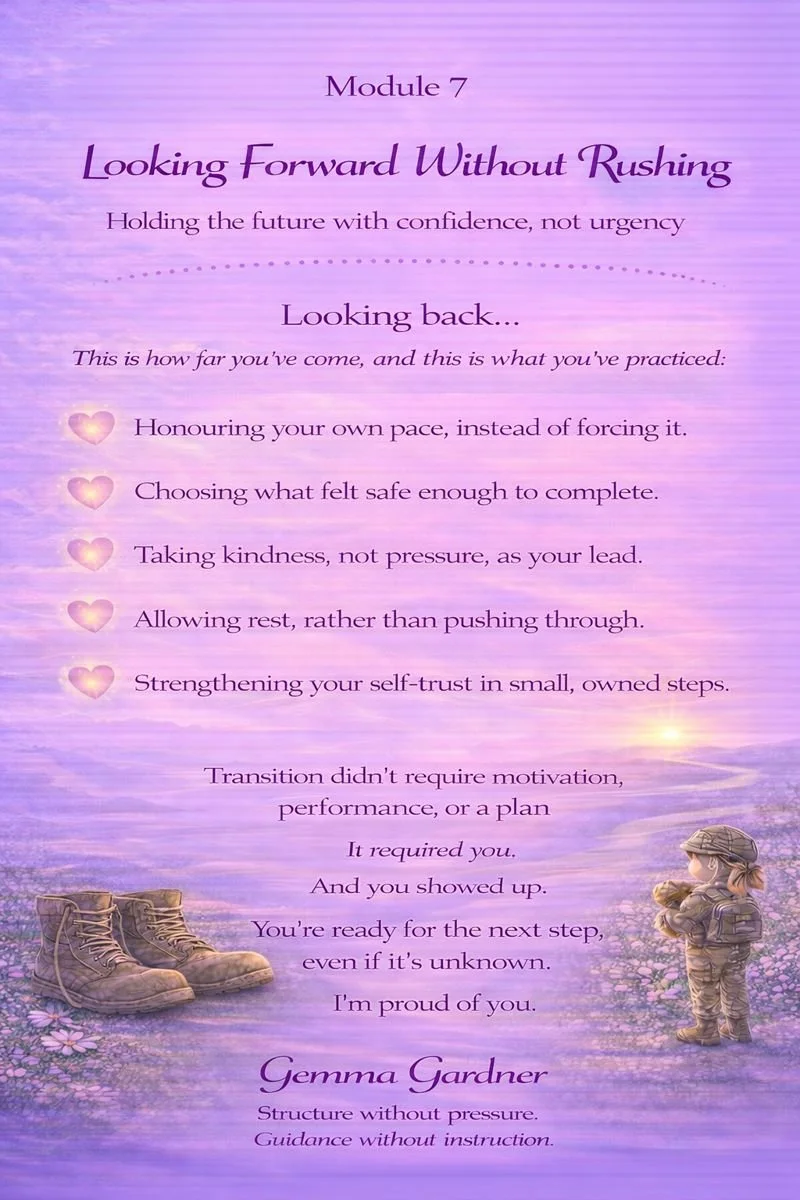
By this point, many people notice something subtle.
Not certainty.
Not a clear plan.
But a little more space.
This final module isn’t about deciding what’s next.
It’s about learning how to hold the future without rushing toward it.
Transition doesn’t end with answers.
It continues with trust.
WHY THE FUTURE CAN FEEL LOADED
During and after transition, the future can carry weight.
Questions like:
“Where am I going?”
“Who am I becoming?”
“What if I choose wrong?”
These questions don’t mean something is wrong.
They mean you care — and that identity is still settling.
Urgency often appears when certainty is missing.
Reflection question
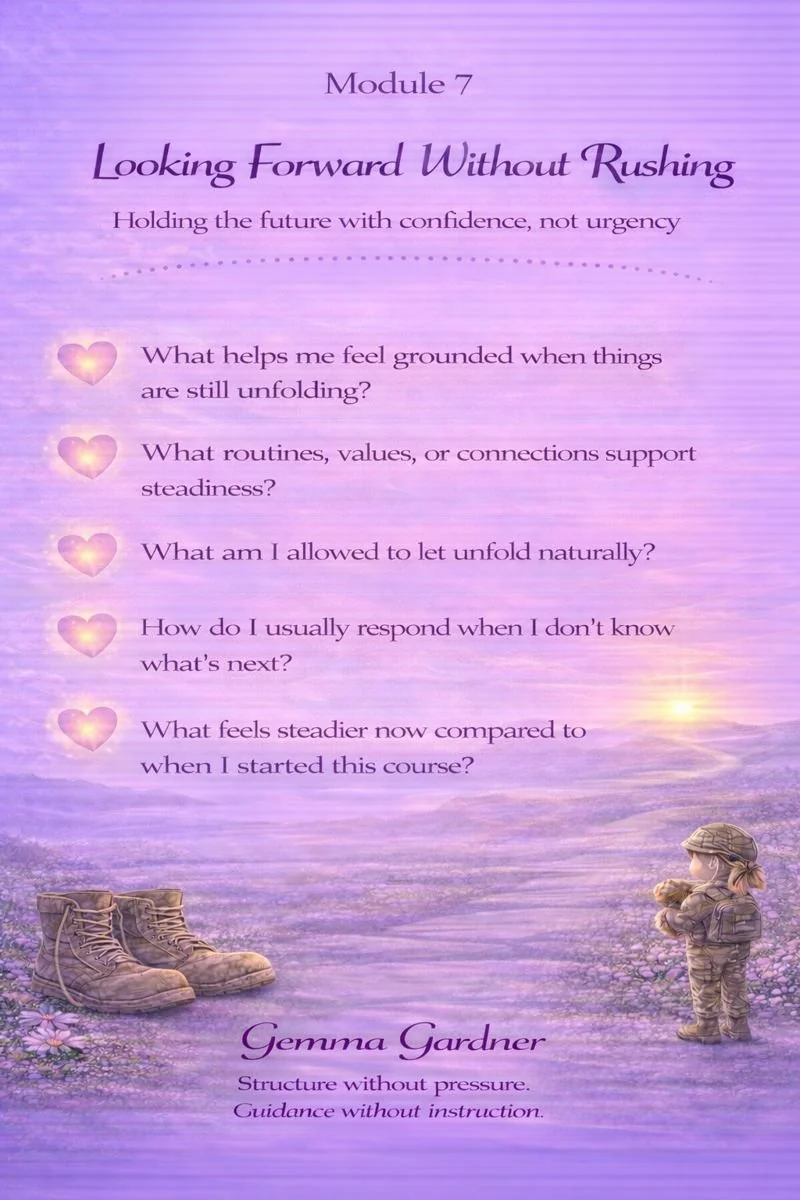
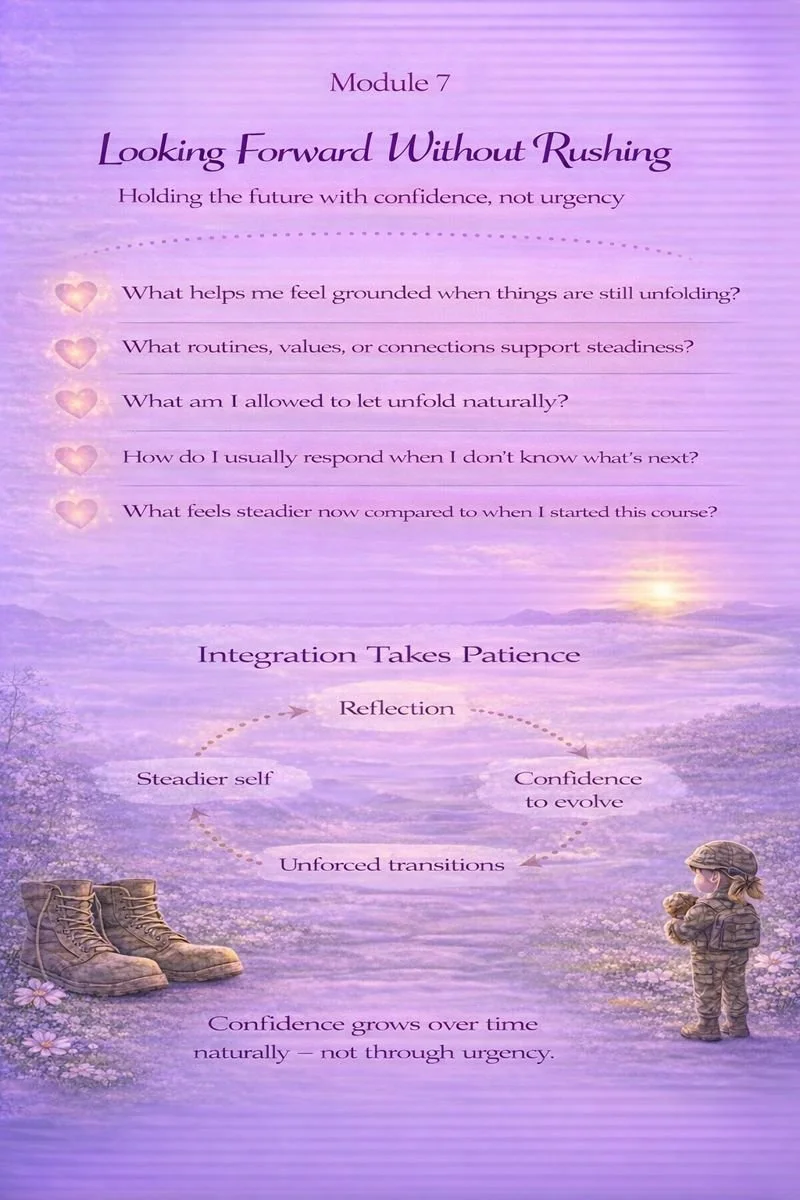
How do I usually respond when I don’t know what’s next?
Guidance
Research into uncertainty tolerance shows that humans often seek premature decisions to reduce discomfort — not because clarity is ready, but because ambiguity feels unsafe.
Learning to sit with “not yet” is a skill, not a failure.
Pause.
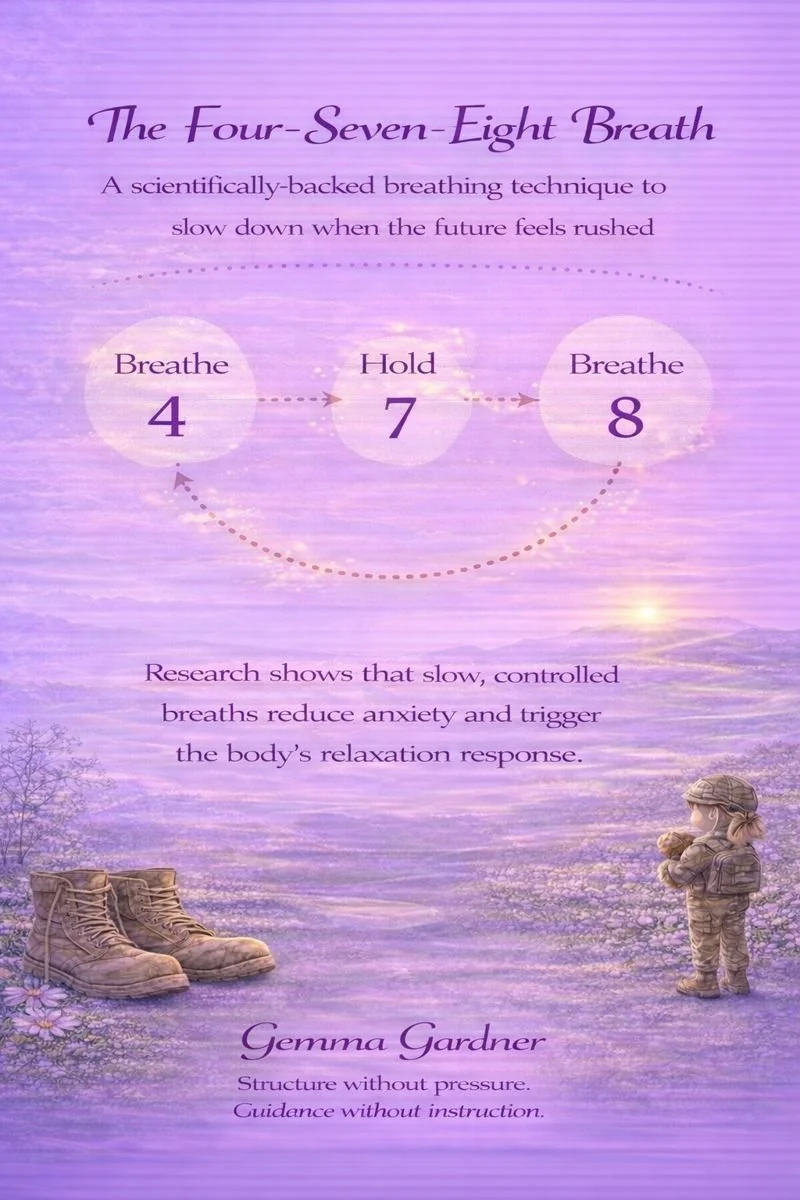
Take one slow breath out.
Nothing needs to be forced.
There’s no rush here. You don’t need answers yet. This module is about seeing more clearly what’s happening inside you right now.
TRUSTING THE PROCESS
Growth during transition rarely happens in straight lines.
It unfolds through:
noticing
adjusting
returning
refining
This is not stagnation.
It’s integration.
You don’t need to know the destination to keep moving in a meaningful way.
Reflection question
What feels steadier now than it did when I began this course?
Guidance
Psychological research into identity development shows that clarity often follows periods of reflection — not the other way around.
Understanding deepens before direction sharpens.
This is how confidence forms quietly.
Pause.
Let that land.
Reflection prompts
What has softened or shifted since I started?
What feels less urgent than before?
What do I trust myself with now that I didn’t earlier?
LIVING WITHOUT A FIXED ENDPOINT
Transition doesn’t end neatly.
It evolves.
There may be future chapters, further changes, or new identities still to come — and that’s not something to rush away from.
Stability isn’t found in certainty.
It’s found in self-trust.
Reflection question
What helps me feel grounded when things are still unfolding?
Guidance
Research on resilience shows that adaptability — not certainty — is the strongest predictor of long-term wellbeing.
Being able to respond, rather than predict, is a strength.
You don’t need the whole map.
Pause here if needed.
Reflection prompts
What anchors me when things feel open-ended?
What routines, values, or connections support steadiness?
What am I allowed to let unfold naturally?
SCIENTIFIC GROUNDING
Studies on post-transition adjustment show that people who allow identity to evolve — rather than forcing reinvention — report greater wellbeing and confidence over time.
Integration happens through lived experience, not decisions made under pressure.
You are not unfinished.
You are continuing.
****
PAUSE
Pause here.
You don’t need to move on.
You don’t need to conclude anything.
Take one slow breath in.
Breathe out gently.
This course doesn’t end with answers.
It ends with understanding, steadiness, and permission.
You’re welcome to return to any module at any time — or simply carry what’s settled and leave the rest.
Thank you for taking the time to reflect.
You can move forward — or rest — in whatever way feels right.