
Identity Architecture
Leadership development that begins from within.
Most development focuses on skills, strategy, or external performance.
Identity Architecture begins earlier — at the level of regulation, responsibility, and professional formation.
It is a structured approach to strengthening the internal foundations that sustain long-term leadership maturity.
THE PRINCIPLE
Leadership maturity does not begin with confidence.
It begins with clarity.
Clarity of identity.
Clarity of responsibility.
Clarity of decision-making under pressure.
Without internal coherence, performance becomes reactive.
With internal structure, performance becomes deliberate.
Identity Architecture provides that structure.
CORE DOMAINS
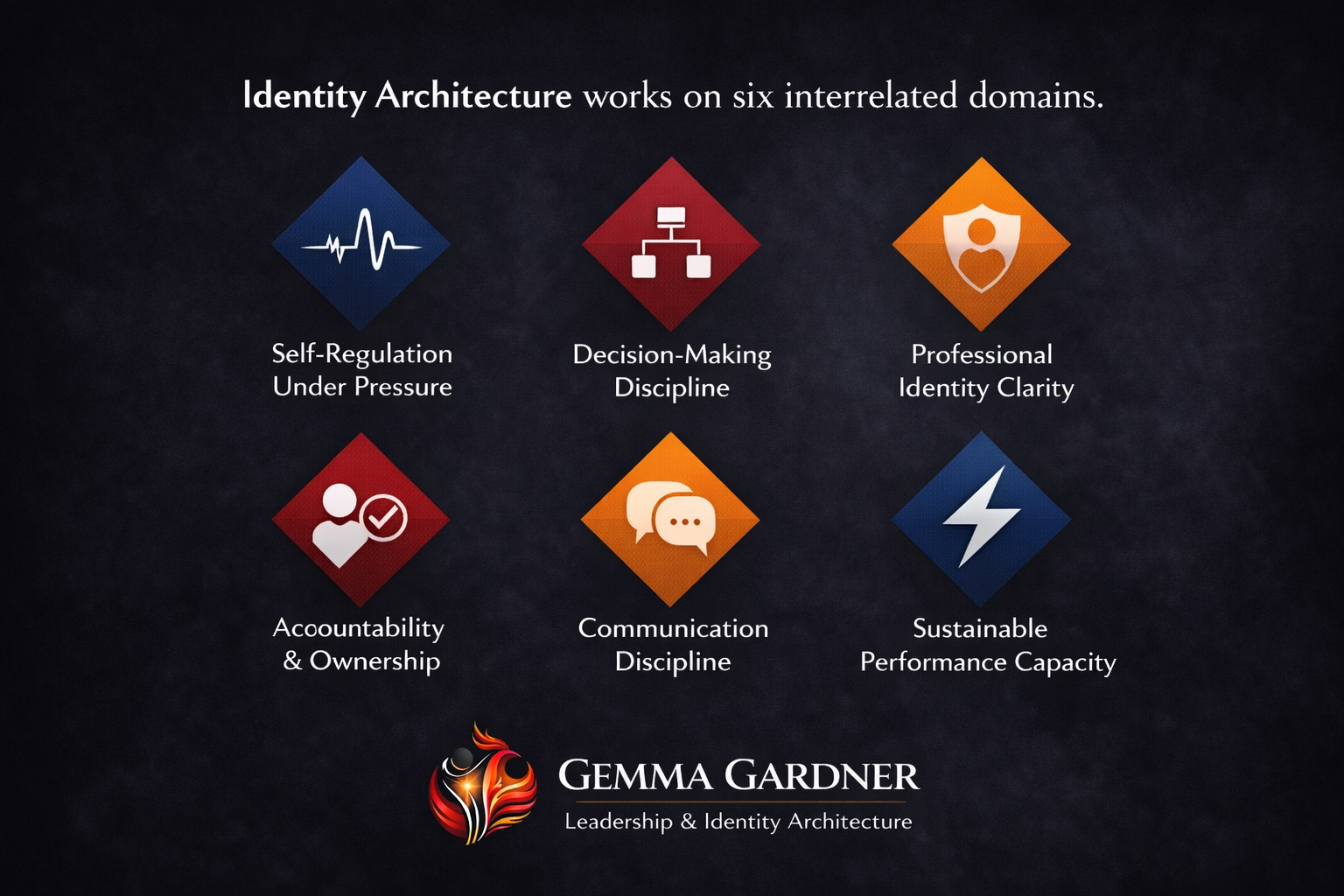
The framework focuses on strengthening six interrelated domains:
Self-Regulation Under Pressure
The ability to remain composed, measured, and disciplined in high-responsibility environments.
Decision-Making Discipline
Structured reasoning, ownership of consequences, and reduced emotional reactivity.
Professional Identity Clarity
A grounded understanding of role, responsibility, and values.
Accountability & Ownership
Moving from deflection to responsibility — particularly under strain.
Communication Discipline
Measured expression, clarity of language, and relational stability.
Sustainable Performance Capacity
Growth that respects long-term resilience rather than short-term intensity.
These domains form the behavioural architecture underlying both individual and organisational development pathways.
“Leadership is not built through intensity.
It is built through identity — formed, tested, and strengthened over time.”
— Gemma Gardner
HOW IT IS APPLIED
Identity Architecture can be applied at three levels:
Foundational Level
A structured introduction for individuals navigating transition or increased responsibility.
Individual Pathway (1:1)
Deeper reflective work designed to strengthen identity integration and disciplined growth.
Organisational Application
Delivered through the Professional Identity Practice Group as a longitudinal behavioural architecture embedded within complex or regulated environments.
While the depth varies, the philosophy remains consistent.
LONGITUDINAL DEVELOPMENT
Sustainable leadership development cannot be rushed.
This framework is designed to support progression over time — not through intensity, but through structured reflection and behavioural alignment.
Growth is measured not by motivation, but by maturity:
• Reduced reactivity
• Increased clarity
• Greater ownership
• Strengthened resilience
• Measured decision-making
The emphasis is not performance theatre.
It is internal coherence.
PHILOSOPHICAL FOUNDATION
My approach draws on developmental psychology, leadership research, and integrative coaching — applied in a way that remains grounded and human.
This is work for people who value depth without overwhelm, clarity without pressure, and growth that strengthens the whole person — not just output.
If you are exploring structured leadership development — whether individually or within an organisation — the next step is simple:
Understand the architecture.
Engage with the pathway that fits your context.
Begin the work deliberately.