

Leadership is rarely formed in moments of comfort.
It is shaped through responsibility, pressure, reflection, and disciplined thinking over time.
Research Notes is an ongoing journal exploring the behavioural foundations of leadership — particularly how identity, responsibility, and internal stability influence decision-making.
These essays examine leadership not as theory, but as lived practice.
WHAT THESE NOTES ARE
Research Notes sit between writing, observation, and applied leadership practice.
They explore themes including:
• identity under pressure
• behavioural discipline
• leadership responsibility
• decision-making clarity
• transition between environments
• emotional regulation in leadership roles
Each piece forms part of a wider body of work exploring how leaders stabilise themselves before attempting to stabilise others.
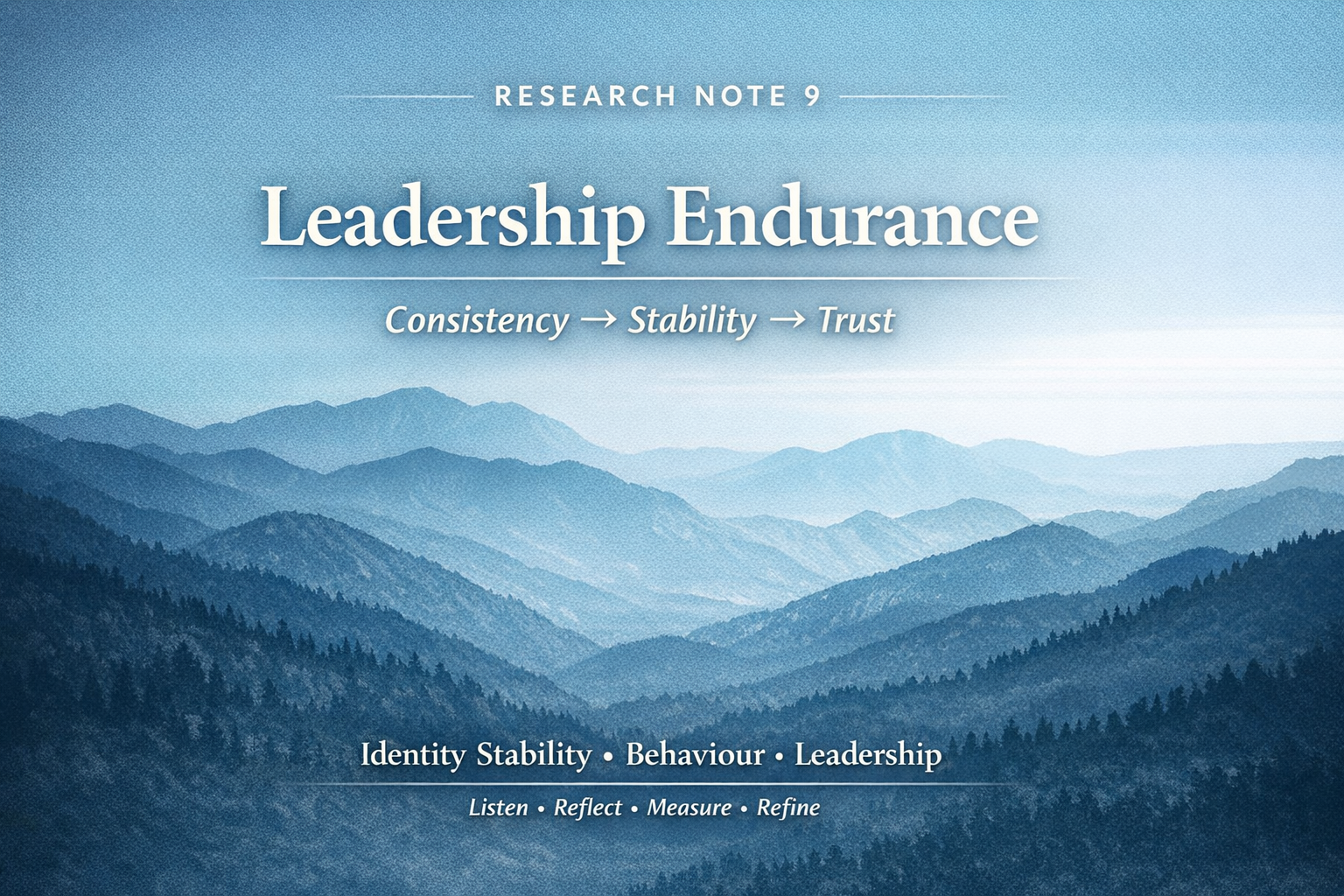
Research Note 9
Research Note 9 explores why leadership stability is sustained through disciplined behavioural consistency rather than intensity, and how identity stability supports long-term leadership endurance.
#Leadership #IdentityLeadership #BehaviouralDiscipline #LeadershipDevelopment #AURISFramework

Research Note 8
Research Note 8 explores how leadership boundaries protect identity stability and prevent behavioural drift under sustained pressure.

Research Note 7
Research Note 7 explores how small behavioural shifts accumulate under pressure and why identity stability protects leadership consistency.

Research Note 6
Research Note 6 examines emotional containment in leadership and how behavioural regulation stabilises decision-making under pressure.

Research note 5
Research Note Five explores how leadership instability often appears after promotion when responsibility expands faster than identity maturity.

Research Note 4
Leadership pressure often creates a sense of overwhelm.
Too many decisions.
Too many uncertainties.
Too many things demanding attention.
This reflection explores why leadership clarity often returns through something far smaller — one disciplined action that restores stability and direction.

Research Note 3
Leadership confidence is often mistaken for visibility.
But the most durable form of confidence is rarely loud.
This reflection explores the discipline of quiet confidence and why internal stability creates stronger leadership over time.

Research Note 2
Leadership rarely collapses because of poor intention.
More often it collapses because leaders react too quickly.
This reflection explores why the discipline of pausing before reacting is one of the most stabilising behaviours a leader can develop.It All Begins Here

Research Note 1
Leadership becomes unstable when attention drifts toward things we cannot control. This reflection explores how focusing on behaviour, effort, and response restores clarity under pressure.
RELATIONSHIP TO THE PHOENIX LEADERSHIP SERIES
Many of the essays published here form part of the Phoenix Leadership Series.
The series explores 52 leadership principles examining the behavioural disciplines that sustain leadership across long careers.
These principles focus on:
• self-regulation
• responsibility expansion
• leadership behaviour
• long-horizon thinking
Each principle builds upon the previous one, creating a structured exploration of leadership stability.
RELATIONSHIP TO THE AURIS FRAMEWORK
The observations explored in Research Notes also inform the ongoing development of the AURIS Leadership Framework.
The framework examines five stages of leadership stability:
Awareness
Understanding
Regulation
Integration
Stability
These essays often explore practical examples of these principles in real-world environments.
WTHE PURPOSE OF THIS JOURNAL
Leadership thinking develops slowly.
It is rarely built in isolation.
Research Notes exists as a space to explore ideas, test observations, and refine principles that later appear in books, programmes, and research initiatives.
Over time, these notes form a record of how leadership thinking evolves.
HOW OFTEN NEW NOTES ARE PUBLISHED
New Research Notes are published regularly as part of ongoing leadership writing and development work.
Many of these essays will later contribute to:
• future books
• leadership frameworks
• pilot research programmes
FOR READERS
If these ideas resonate with your own leadership journey, you are welcome to explore further through the Phoenix Leadership Series, the AURIS Framework, and the Identity Journal.
Explore the Phoenix Leadership Series
Explore the AURIS Framework
“Identity is not discovered in comfort.
It is revealed in responsibility.”
— Gemma Gardner